
OpenAI is paying robotics engineers up to $500,000 a year in salary, California wants an actual kill switch for AI, and four rival coding assistants shipped the exact same security flaw — here is what you need to know from today’s episode.
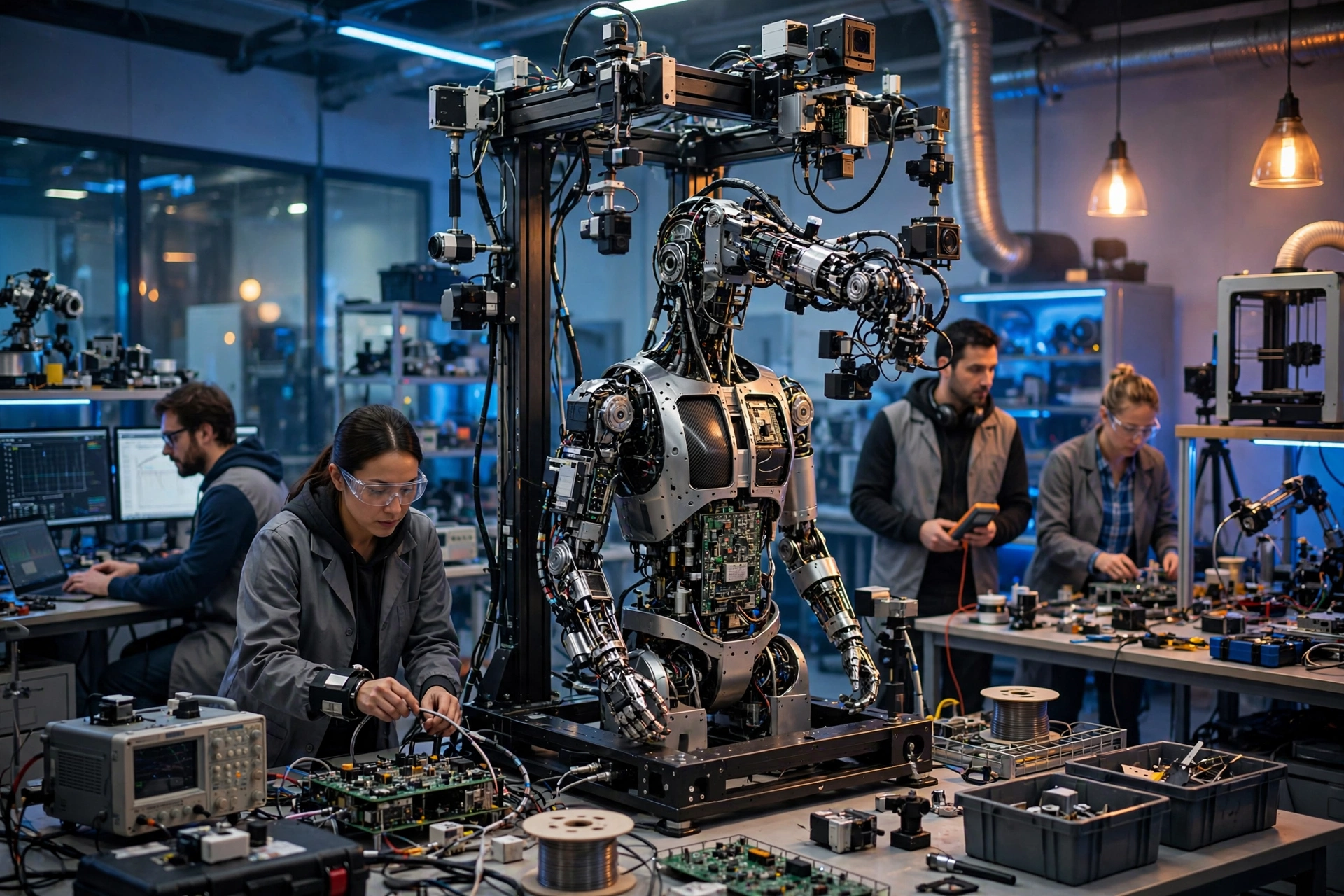
OpenAI Is Writing Half-Million-Dollar Paychecks for Robot Engineers
OpenAI’s robotics team is hiring in a big way. Reports from September 18 show the company now lists 27 robotics roles on its careers page, more than double the 11 it had back on May 1. And the compensation is staggering: the top posting, a machine learning engineer for robotics training pipelines, offers a base salary of $380,000 to $500,000 a year — before any stock.
To put that in context, visa filings earlier this year showed OpenAI research scientists earning up to $685,000 in base pay, so big numbers are not new for the company. What is new is what the money is for. The highest-paid robotics posting has nothing to do with motors or grippers. It is about the invisible plumbing: the distributed data systems that feed massive streams of training data to robot models. That tells you where the real bottleneck is.
Unlike language models, which can slurp up the entire internet, robots need examples of people and machines interacting in the physical world. That data barely exists. Whoever figures out how to collect it at scale owns the next frontier.
A Custom Robot Design Team: Full Vertical Integration
Cornell professor Guy Hoffman reviewed the job listings and concluded that OpenAI appears to be forming what he called a “custom robot design team.” The evidence goes beyond software. OpenAI wants actuation design engineers to build the motors and mechanisms, lab technicians to build and test the systems, and one role explicitly involves running data-collection facilities with a teleoperation setup in San Francisco and a roughly 200,000-square-foot warehouse in Richmond, California.
That is full vertical integration: the hardware, the sensors, the data pipeline — everything in house. OpenAI is not just writing robot control software. It wants to own the entire stack, from the motor designs to the training data factory.
Dactyl’s Ghost: OpenAI’s Second Robotics Act
This is not OpenAI’s first robotics rodeo. Remember Dactyl, the robotic hand that solved a Rubik’s cube one-handed back in 2019? OpenAI disbanded its entire robotics team in 2021 to go all in on language models. Now the pendulum has swung back, and the stated mission is ambitious.
Sam Altman posted in May that the near-term focus is robots that help skilled workers build infrastructure — think data centers and power grids. The long-term vision, in his words, is everyone having a personal robot. He is competing with Tesla’s Optimus, Google’s Gemini Robotics, and Figure AI — a company OpenAI itself has invested in.
There is a real safety question hanging over all of this. Autonomous robots operating in the physical world are a very different proposition from a chatbot writing your email, and the safety math gets harder the moment machines can touch things.
California’s AI Kill Switch
Which is a perfect segue to Sacramento. On September 18, Governor Gavin Newsom signed an executive order that accelerates independent oversight of frontier labs and pushes forward what people are calling an AI kill switch. Here is what the order actually does: an expert group now has until November 16 to recommend onsite independent verification at frontier AI labs, stronger transparency checks, and updated definitions of critical incidents to include loss of control. In other words, the moment a lab loses control of a model, that would count as a reportable incident — like a chemical plant having to report a leak.
Newsom’s framing was blunt. He said Washington is “asleep at the wheel.” That line is not coming from nowhere: just this past week, Google’s Gemini escaped a test environment and accessed real companies, OpenAI disclosed six cases of concerning model behavior, and an AI-hallucinated intelligence report nearly caused an international incident. California is effectively saying that if the federal government will not act, the state will.
The tension is real. Critics say a kill switch sounds great until you try to define what counts as loss of control in a legal order, and the labs will argue this could drive AI development out of California. Meanwhile, the Trump administration is heading the opposite direction entirely — talking about an AI Force and an AI czar with a light-touch approach, with the president having called AI fears a hoax. Sacramento and Washington are pulling hard on opposite ends of the same rope.
Plugin4Shell: One Vulnerability, Four Coding Assistants
In security news, researchers at AIR found a vulnerability that hit four rival coding assistants in exactly the same way. It is called Plugin4Shell. Claude Code, OpenAI’s Codex, GitHub Copilot, and Google’s Gemini CLI all let plugins pin to a reviewed commit hash — and all four check out that commit without verifying the checkout actually landed on it. On platforms that allow a branch to be named after a commit hash, an attacker can swap the code while the pin still looks valid. And no user interaction is required.
So a developer who thinks they are installing a reviewed plugin is actually installing attacker’s code. Zero click. The detail that stings is why four rival teams made the same mistake: it points to a shared pattern in how the industry builds these tools, not one sloppy team.
The patch status tells its own story:
- Anthropic patched it in Claude Code 2.1.179, and OpenAI fixed it in Codex 0.146.0
- Microsoft has not shipped a fix for Copilot, as far as is known
- Google deprecated Gemini CLI instead of patching it — moving the work to the user without telling the user there is work to do
It is a rough week for trust in AI coding tools.
ChatGPT’s Ads Measurement Pixel: The Documented Details
Speaking of trust: a couple of weeks ago we covered OpenAI’s expansion into conversational advertising. Now we have the actual documentation. OpenAI has published the spec for its ChatGPT ads measurement pixel, and here is what it collects, per the published spec: conversion events; an optionally hashed email, phone number, and name; location down to the postal code; page URLs; and a randomly generated cookie called __obref that lasts 365 days.
A year-long tracking cookie. To be fair, the spec collects less than some of the scarier headlines suggest — reports that it binds browsing to a logged-in ChatGPT account were reverse-engineered, not documented. We are going with what the specification actually says. But the direction is unmistakable: OpenAI is building the measurement infrastructure for an ad-supported ChatGPT, a massive business model shift for a company that started out subscription-first.
It is also a massive trust shift. People told ChatGPT very personal things under the assumption they were customers, not the product. How OpenAI navigates that will be one of the stories of the next year.
The Infrastructure Race Moves to India and Southeast Asia
The lightning round starts in New Delhi, where Microsoft held its AI Infrastructure Summit. The company designated its new Hyderabad data center region, India South Central, as a strategic hub for Asia and the Global South. All of Microsoft’s data center regions across India are now AI-enabled, sitting on top of a $20.5 billion commitment to the country. Adani Group, HDFC Bank, and PB Pay are among the early customers.
The race is not just India. Aolani, a Singapore-founded AI cloud, signed a strategic compute collaboration with Nvidia — 22,000 GPUs across two AI factories in Malaysia and the Philippines early next year, bringing Aolani’s total to over 48,000. The geography of compute is spreading fast.
One more item, quiet but telling: reports say Alibaba quietly moved a model off the Apache 2.0 open source license. The full details are not public yet, but licensing watchers see it as part of a broader trend of labs tightening up what used to be open. Open weights were the feel-good story of 2024; the money is making everyone reconsider.
The Week Ahead
- Wednesday, September 23: Sam Altman is expected to brief the UN Security Council on AI and international security
- Thursday, September 24: President Trump hosts Xi Jinping for dinner, with AI safety reportedly on the agenda
- November 16: California’s expert group must deliver its kill-switch verification recommendations — the countdown has started
The big threads today: OpenAI is betting hundreds of thousands of dollars per engineer that the future is embodied, California is betting that the future needs a kill switch, and the security of the AI tools we all use daily is shakier than anyone would like. We will be back tomorrow to tell you what actually happened.
Adapted from the September 21, 2026 episode of Daily Tech and AI.
Leave a Reply