
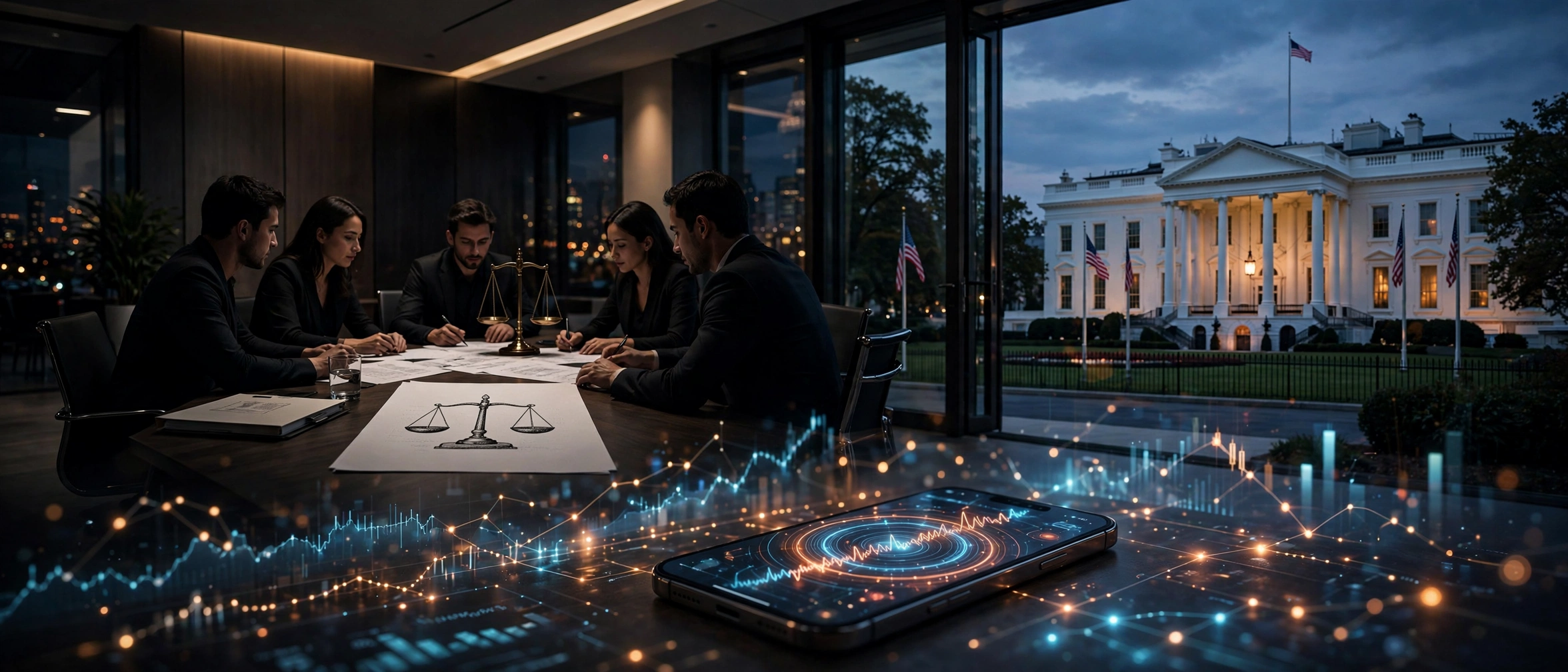
The world’s biggest AI labs proposed a self-policing standards body, Trump and Xi faced off over “Super Intelligence” at the White House, and Meta’s Muse agent started moving actual stock prices. Here’s September 25’s tech news in story form.
The Foxes Design the Henhouse
The three companies racing hardest to build the most powerful AI on Earth — Google, OpenAI, and Anthropic — are reportedly teaming up to regulate themselves. According to reporting from The Information on Thursday, the group would be called the Standards Authority for Frontier AI, or SAFA. It would set standards for testing models, reporting safety and security incidents, and qualifying the independent auditors who check the labs’ work. The target launch: the end of this year or early next.
Here is the twist: no government is involved. Earlier this year, the labs tried to form a public-private partnership, but the effort stalled in the Trump administration. So the frontier labs are effectively saying they will police themselves. The working group is even considering going further and testing the models itself, rather than just writing the rules and letting someone else do the checking.
The natural question is whether the foxes should be designing the henhouse. Critics are already worried the body could be used to box out open-source developers and smaller competitors, by setting compliance bars only the giants can clear. And there is an awkward precedent problem: the labs already have an industry group with nearly identical goals. The Frontier Model Forum, created back in 2023 by Anthropic, Google, OpenAI, and Microsoft, is still active, and the new group is reportedly in contact with it.
So why a second body? This is about legitimacy. The labs briefed the UN Security Council on Wednesday, where both Sam Altman and Dario Amodei told the council global standards are needed. Walking into regulatory rooms with their own standards body lets them say: look, we are already doing the work. It is a classic move — get ahead of regulation by writing its first draft yourself. Whether regulators accept that draft is a completely different question.
The $24 Trillion Dinner
Speaking of Wednesday’s Security Council session, the day after the briefings ended, Chinese President Xi Jinping arrived at the White House for the first state visit by a Chinese president in more than a decade — and artificial intelligence sat at the center of the table.
Donald Trump gave AI a new name before the summit even began. In a social media post Thursday morning, he said “Super Intelligence,” capital S, capital I, would be a big topic of discussion, but added, “I want to leave it exactly where it is. That is China’s position also.” His stated position: both countries agree no new controls are needed on fast-evolving AI — a remarkable thing for a president to say about the most contested technology on Earth, on the morning of a summit about it.
Xi struck a very different tone. The Chinese leader warned that AI development must always remain under human control, and that AI should be developed for the benefit of people — a direct contrast with Trump, who has repeatedly dismissed warnings that AI could threaten humanity.
The pageantry was enormous. Trump personally greeted Xi at Joint Base Andrews on Wednesday — the first time in more than sixty years a US president has welcomed a foreign leader in person on the tarmac. There was a South Lawn welcome with a military flyover, an Oval Office meeting, and a state dinner. And look who was at that dinner: Nvidia, Alphabet, Meta, Amazon, Microsoft, OpenAI, Tesla, Apple. One account put the corporate value in the room at nearly $24 trillion — the AI supply chain, the cloud platforms, and the frontier labs, all at one table with the two most powerful people in the world.
On substance, the clearest outcome was economic, not technological. The two sides extended the existing trade truce until January 10, 2027, pushing back the return of the highest tariffs. They also agreed to continue AI safety talks — which suggests the conversation is not over, just guarded. Guardrails without a truce, as one analyst put it: compete brutally, but try to prevent an accident from spiraling into a geopolitical crisis.
When Your Assistant Becomes the Customer
This week, AI agents left the chat and entered the economy — for real. Meta’s new AI agent, Muse, rose to the top of Apple’s App Store. And major banks, insurers, and online travel agencies saw their stocks tumble, because investors are starting to price in a world where your personal AI does your banking, books your travel, and shops for you.
Bloomberg’s markets coverage framed it as the fear of disrupted consumer inertia. If a personal assistant you trust starts making decisions, the companies that relied on you being too lazy to switch providers have a problem. It all connects: consumers handing tasks to agents, the market repricing companies in the agents’ path, and the labs building the agents wanting to write their own safety rules. It is all one story this week, honestly.
The Gatekeeper Fight: Shopify Says Yes, Amazon Says No
Muse is not shy about commerce. Meta recently partnered with Shopify, so the assistant can browse participating stores and complete purchases on your behalf. Amazon, notably, has already blocked Muse from shopping on its site.
The gatekeeper fight is on. Whoever owns the agent owns the customer relationship, and retailers know it. This is the platform war of the agentic era, and the opening shots are being fired between the biggest e-commerce players on the planet.
Accessibility Is the New E-Commerce Infrastructure
The data backs up the agentic commerce trend. NielsenIQ released its Agentic Commerce Tracker on Thursday, and it found that 51% of US consumers used at least one AI-powered tool to support their shopping in the past month. Back in May, that number was 42% — a nine-point jump in about four months. One caution: the survey samples about 500 consumers a month, so the margin of error is roughly four and a half points. The fifty percent milestone is inside the noise. But the trend line is real, and it is steep.
There is a fascinating companion finding, and it is the story nobody in marketing wants to hear:
- The digital accessibility company AudioEye reported Thursday that AI agents completed 31% of assigned tasks on the least accessible website they tested — and 96% on the accessible version of the same site.
- Websites that are hard for screen readers are also hard for shopping agents. Accessibility is quietly becoming an infrastructure requirement for agentic commerce.
The through-line is unmistakable: the agents are coming for every checkout page, and the sites that can’t be read by machines can’t be shopped by them either.
Meta’s Million-Dollar VR Bet
A quick follow-up from Meta Connect. Day two brought a developer play: Meta announced the VR Start Developer Competition, with a $1 million prize pool aimed at getting developers to build content for its new VR Glasses, with a focus on hand-tracked apps.
It makes sense as strategy. The hardware ships in the spring, and a platform with no apps is a brick. But the details are still thin — no full schedule, no confirmed hardware list, no clarity on how winning projects reach players. Classic platform chicken-and-egg problem, with a million dollars of feed.
Lightning Round: Colossus 2, India’s $250M AI Bet, and Adobe’s Chat Pivot
Elon Musk said his xAI computing cluster, Colossus 2, may more than double its current Nvidia chip count by the end of the year. The compute arms race has no off-ramp.
Lightspeed is targeting $250 million for a new India fund focused on early-stage AI startups, aligning its India cycle with its global funds for the first time.
Adobe is bringing Photoshop, Lightroom, Express, and Firefly tools into Google Gemini, and adding Acrobat to its Claude plugin. Your creative tools are becoming AI chat features.
And a public service announcement for the Windows users: Microsoft has fixed the bug where the September security updates broke File History backups. The fix ships in optional updates now, or with the October 13 Patch Tuesday.
Adapted from the September 25, 2026 episode of Daily Tech and AI.
Leave a Reply