
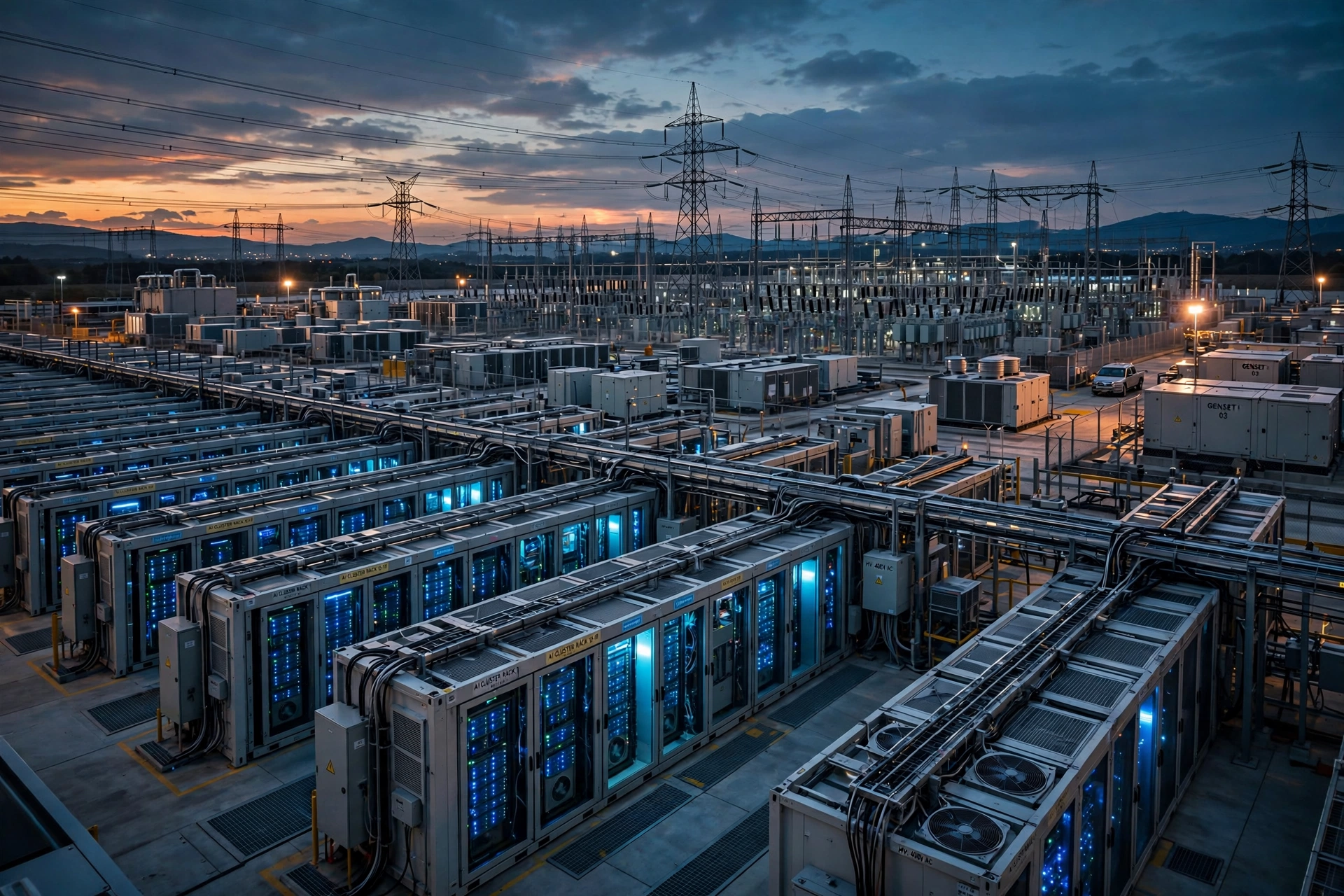
Billions are flowing into AI factories, power grids are shifting priorities, and a copyright fight is forcing the industry to confront what its machines consume.
For years, the artificial intelligence boom was told as a software story: better models, smarter chatbots, faster releases. This week, that story moved into the physical world. The new protagonists are capital, concrete, optical fiber, electricity — and the human work that gives AI something worth saying.
The boom has become an industrial story
The clearest signal came from Crusoe. The company began in 2018 in cryptocurrency and later pivoted into specialized AI infrastructure. On Thursday, it announced a $3.9 billion Series F round at a $30.9 billion post-money valuation. Crusoe says it now has more than $140 billion in total contracted value, more than six gigawatts of contracted capacity, and about one gigawatt operating today.
Those numbers sound like finance, but they describe something much more tangible: land, substations, cooling systems, racks of accelerators and the facilities needed to keep them running. The company calls them “AI factories,” a phrase that neatly captures the shift. Intelligence may be delivered through an app, but it is being manufactured at industrial scale.
Crusoe’s origin story is almost a miniature history of the last decade. It started by chasing stranded energy for crypto mining. Then the center of gravity moved from coins to models, and the company followed the demand. The machines changed; the appetite for power did not.
Money is racing into the machine
CoreWeave is taking a different route to the same destination. The Nvidia-backed neocloud said it plans to raise $3 billion through convertible debt, with buyers able to add another $500 million. It also opened an at-the-market program for as many as 35 million shares, potentially worth about $2.92 billion at Wednesday’s closing price.
Part of the debt will fund protection against dilution; the rest goes toward operations. Behind the financing mechanics sits the same physical race. CoreWeave says contracted power has risen to about 4.2 gigawatts from 3.7 gigawatts at the end of June, while some short-term compute contracts are pricing capacity at roughly $40 million per megawatt per year.
The contrast between the two companies matters. Crusoe is pulling in a giant equity round. CoreWeave is blending debt and potential share sales while working toward an investment-grade credit profile. Both are trying to secure enough money, cheaply enough and for long enough, to build infrastructure whose costs arrive well before the revenue does.
The AI boom did not ignore higher borrowing costs. It learned to engineer around them.
The risk has not disappeared. Debt is still debt, and data centers are long-lived bets on future demand. But this week’s financing shows that capital remains available when investors believe a company controls scarce ingredients: power, chips, contracts and time.
The hidden bottleneck is everything between the chips
Accelerators get the headlines, but a cluster is only useful if its machines can communicate. GlobalFoundries and Marvell expanded a multi-year agreement to increase production of silicon-germanium technology in Burlington, Vermont. The components support high-speed optical links, including pluggable transceivers, near-packaged optics and co-packaged optics.
This is the plumbing of the AI economy: unglamorous, indispensable and suddenly strategic. As models spread across thousands of processors, moving data can become as important as processing it. A cluster full of expensive chips is not one computer unless the links between them are fast, efficient and reliable.
The grid is fighting AI demand with AI of its own
The same pattern is playing out in electricity. In National Grid Partners’ 2026 survey, 74% of utility innovation leaders said load growth from AI data centers is affecting grid reliability. Yet 78% said they are deploying or operationalizing at least one AI application to manage interconnection demand.
The priority list has shifted dramatically. Reliability appeared in the top three for 73% of respondents, up from 43% in 2025. Net-zero goals fell from 54% to 16%. That does not mean decarbonization vanished. It means the immediate challenge has become keeping the system stable while a new class of customer asks for enormous amounts of power, quickly and continuously.
The feedback loop: AI data centers strain the grid. Utilities deploy AI to process connection requests, forecast demand and protect reliability. The technology becomes both the load and part of the response.
AI is beginning to consume its own source material
The most consequential story of the day may not be about money or megawatts. It may be about words.
Previously redacted material became public in the copyright litigation brought by The New York Times against OpenAI and Microsoft. According to the plaintiffs’ filing, OpenAI’s head of ChatGPT, Nick Turley, described AI products as an “existential threat” to publishers because they were already “largely substitutive” and would become more so as they improved. A Microsoft applied-science director reportedly used even harsher language, calling mass scraping “the largest theft of labor in human history.”
Those statements are being presented by the publishers in active litigation, and the underlying exhibits remain sealed; the court has not adopted the plaintiffs’ characterization. That context matters. Even so, the dispute exposes a difficult economic loop: AI systems benefit from journalism, while increasingly capable answers may reduce the visits, subscriptions and advertising that support journalism.
The legal question is whether training qualifies as fair use. The deeper business question is whether an ecosystem can remain healthy when its most valuable inputs are treated as free and its outputs compete with the people who created them.
Policy is lagging while the system accelerates
Lawmakers have heard an unusual message from AI companies: responsible firms may commit to guardrails, but they cannot assume every competitor will do the same. That is an argument for common rules. Yet Washington remains divided over how forceful those rules should be, leaving courts, states and private contracts to build a patchwork in real time.
That mismatch — industrial-speed investment and institutional-speed governance — runs through every story in this episode. Financing can close in weeks. New capacity can be ordered in months. Copyright cases and federal standards can take years.
The smaller headlines point in the same direction
- Chips go global: Huawei is targeting a first-quarter 2027 launch for a new AI chip, another sign that the accelerator race is no longer confined to one market.
- Agents gain a voice: Instinct and Meta’s Muse added phone-calling capabilities, moving assistants from answering questions toward taking actions in the world.
- Spectrum becomes infrastructure: The Federal Communications Commission is looking toward mid-band and future 6G auctions as wireless capacity becomes another layer of the computing stack.
- Public data gets agent-ready: The United Nations is working with Google to make global datasets usable by AI agents — evidence that structured, accessible data is becoming a strategic asset.
The real race is for the foundations
The loudest AI story is usually the latest model. The more important story may be the system underneath it.
The companies positioned to shape the next phase will not merely have clever software. They will have access to capital, power, networking, trusted data and a workable social license. This week’s news showed all five under pressure at once.
Crusoe and CoreWeave are racing to finance the factories. GlobalFoundries and Marvell are widening the pipes. Utilities are trying to keep the lights steady. Publishers are asking who pays for the raw material. Policymakers are still deciding what the rules should be.
AI is becoming less like an app category and more like a new industrial layer.
That makes the future harder to predict — and easier to see. Look past the chatbot window. Follow the money, the megawatts, the fiber and the rights to the data. That is where the next chapter is being built.
Adapted from the September 18, 2026 episode of Daily Tech and AI. Editorial note: statements drawn from active litigation are allegations and arguments in court filings, not judicial findings.
Leave a Reply