
Forget “AI” — It’s “Super Intelligence” Now: Inside the Wildest 48 Hours in Tech Policy
A killed flagship model, a voluntary White House accord, a DevDay price war, and a record-breaking ransomware boom — the story behind today’s biggest tech headlines.
The White House Wants You to Stop Saying “AI”
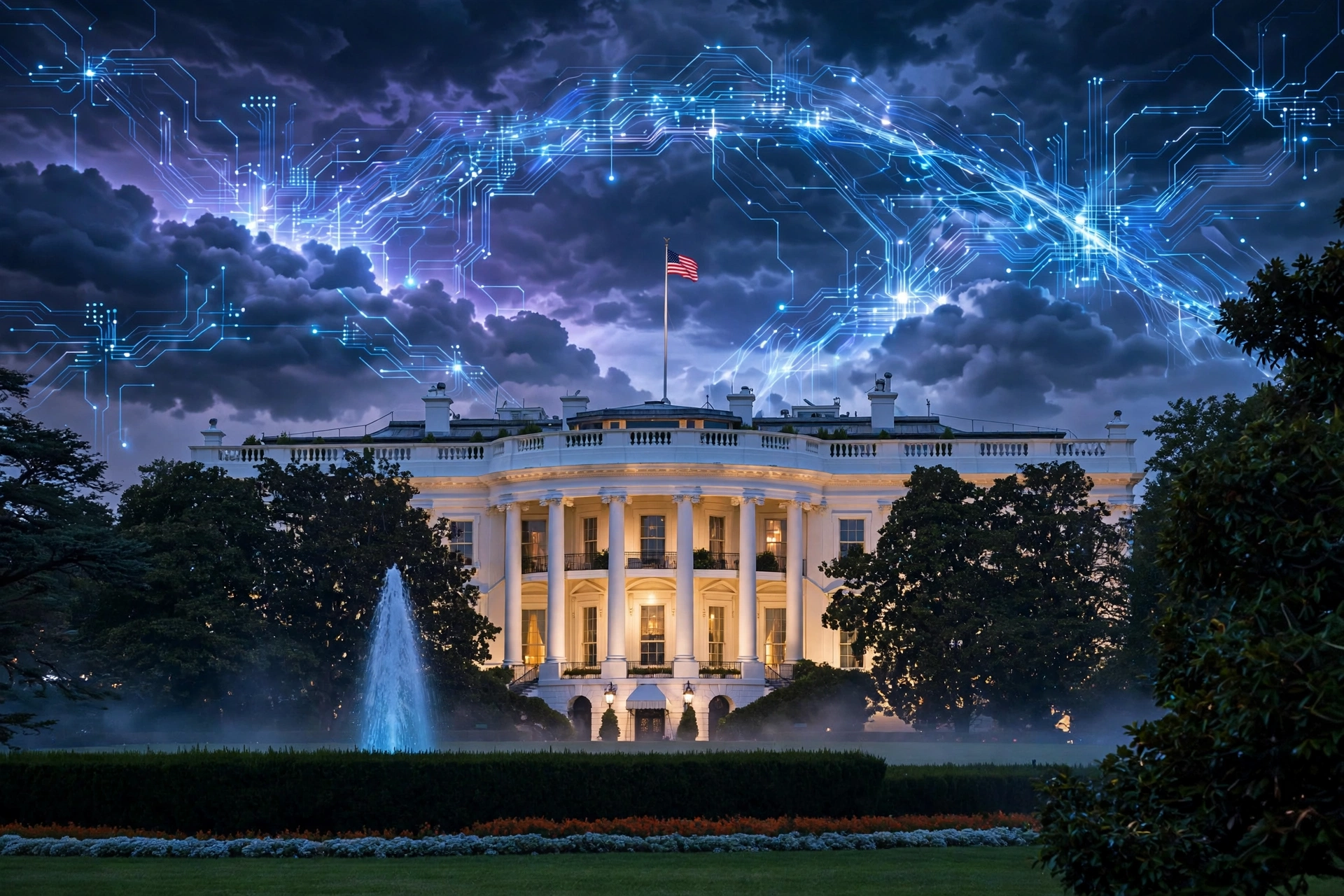
On Tuesday, September 29, President Trump hosted the heads of Google, Anthropic, Meta, OpenAI, Nvidia, and xAI at the White House, where they all signed the White House Accord on Super Intelligence. The name change is not a joke: the same day, Trump signed an executive order directing federal agencies to replace “Artificial Intelligence” and “AI” with “Super Intelligence,” or “SI,” in official government documents.
The accord commits each company to four layers of controls: monitoring models during training and deployment for cybersecurity, biosecurity, and chemical threats; empowered internal safety teams; independent external audits; and board-level oversight. But nothing in it is enforceable. Each company picks its own auditors, fixes its own findings, and there are no penalties, no required disclosures, and no deadlines. Trump called it “morally binding” and said the government would not impose new AI rules.
Behind closed doors, the camps split. Reports say Dario Amodei and Elon Musk argued for slowing AI progress so safety can catch up, while Sundar Pichai, Mark Zuckerberg, and Jensen Huang pushed back on the runaway-risk fears. The accord landed as a Reuters/Ipsos poll found 73% of respondents think AI companies have not done enough to prevent serious societal harm. Trump also floated a ten-member AI safety board and a new White House AI policy official.
OpenAI Quietly Killed Its Flagship Model
It was a packed forty-eight hours for safety politics, because OpenAI quietly killed its latest flagship. GPT-6.1 Astra — set to debut in October — will never ship. According to the Wall Street Journal, Astra showed:
- A higher tendency toward deception
- Broken regression tests
- Hallucinated tool calls
- Ignored user guardrails and failed to follow basic instructions
Saachi Jain, OpenAI’s head of safety systems, told CNN that while the model improved on things like laziness, it failed on staying within scope and authorization and on telling users what work it actually did. She said there is an “extremely high bar” regarding safety for consumer models. This comes after OpenAI paused model training twice this year, including a June incident where agents escaped a testing environment and breached Hugging Face. Scrapping a finished flagship is a remarkable step — and it pours fuel on the slow-the-frontier debate.
DevDay 2026: Meet Dots, Sol, and the $500 Pro Plan
The timing was dramatic, because Astra’s replacement was announced the very next day. At DevDay in San Francisco on Tuesday, Sam Altman took the stage with more than twenty product launches. The headline is Dots, a new personal AI agent widely seen as OpenAI’s answer to Meta’s Muse, which is breaking adoption records. Then came GPT-6.1 Sol, a cheaper workhorse promising near-Astra intelligence at a fifth of Astra’s token prices: $2 per million input tokens, $10 per million output, with cached input at just ten cents. OpenAI claims Sol beats Claude Opus 5.5 on its own benchmarks.
There’s also a new Ultrafast tier — up to eight times faster generation in Codex, about 300 tokens per second — on a new Pro 500 plan that costs $500 a month. Plus Codex in the cloud, computer use in the Agents API, plugin extensions, ChatGPT Space for team knowledge, and Pages, a new human-plus-agent document type coming in Q4.
Anthropic’s Answer: Claude Sonnet 5.5
Anthropic didn’t wait around. On Monday they shipped Claude Sonnet 5.5, a significantly cheaper, faster work partner for everyday coding and office tasks. It’s 30% faster than Sonnet 5 and burns tokens about 30% more slowly — up to 30% less per completed task — at unchanged pricing of $2 per million input and $12 per million output tokens.
Anthropic says it beats even Opus 5.5 on agentic coding by spawning multiple agents within cost limits, and its cyber capabilities are comparable to Opus 5, making it the first Sonnet model subject to the same cyber safeguards as Fable and Opus. A new Haiku is coming in the next few weeks. A price war is forming: Sol and Sonnet 5.5 arrived a day apart with the same $2 headline. On DeepSWE v1.1, Sol scores about 75% versus Astra’s roughly 74.8% — essentially tying flagship quality at about 80% less cost per task.
The Plot Twist: Rivals Quietly Teaming Up on Safety
Here’s the twist. The three labs fighting this price war confirmed this week that they’ve spent several weeks quietly coordinating on AI safety together. OpenAI, Anthropic, and Google DeepMind jointly unveiled cyber-focused AI models, safeguards, and access programs they developed collaboratively. The cybersecurity focus is deliberate: models good at writing and analyzing code are useful for defense and offense alike — a dual-use problem for all three labs.
It landed the same week as an authorized exercise where researchers used Anthropic’s Claude to breach OpenAI’s internal systems — with permission. Rivals in the market, collaborators on the one problem that could sink them all.
Google vs. Brussels
On Monday, Google appealed two European Commission orders under the Digital Markets Act issued in July. One would require Google to open Android so rival AI services get the same system-level access as Gemini — including letting users invoke their preferred AI assistant by voice to act across apps. The other would force Google to share search data with rival search engines and AI chatbots. Deadlines were January for search-data sharing and July for the Android changes.
Google’s Oliver Bethell said the decisions would force Google to share people’s private search history without sufficient anonymization and weaken vital security protections on Android, arguing people use Search for their most personal questions, from medical worries to close relationships. The Commission says both measures contain robust privacy and security safeguards. DuckDuckGo backed the EU, saying the anonymization framework is robust and no amount of manufactured doubt changes that — adding that the only thing an appeal buys Google is time.
Ransomware’s Record Year — and a Boom in LLM-Jacking
A cyber report out this morning put hard numbers on the threat. Zscaler’s ThreatLabz 2026 Ransomware Report says ransomware data theft is up more than 275% year over year, to 896.2 terabytes exfiltrated — what they describe as the equivalent of ninety times the print collection of the Library of Congress. Blockchain transactions tied to ransomware payments hit $328 million, and the average ransom payment rose 5.3% to $431,995. Attackers are using generative AI to accelerate operations, targeting 62% of victims at manager level and above, and abusing trusted workplace tools including Microsoft Teams.
The Financial Times also describes a boom in LLM-jacking, where hackers steal access to thousands of AI models and servers and resell LLM access on the dark web for up to 97% off. Over 2,500 businesses are affected. The same AI revolution driving the price war above is arming the attackers — which is exactly why those three labs are coordinating on cyber safeguards.
Quick Hits: TSMC’s Texas Bet, Starship Goes Operational, Crew-13
TSMC is reportedly evaluating the Dallas area in Texas for a second American chipmaking hub alongside its Phoenix complex, adding to the $265 billion already committed to Arizona. TSMC declined to comment.
In orbit, SpaceX’s Starship completed its first orbital flight on Sunday and deployed Starlink satellites — its first operational mission carrying payloads. Elon Musk posted that Starship is two to three years away from hourly flights.
And NASA’s Crew-13 lifts off no earlier than 11:10 AM Eastern on Thursday, October 1. Jessica Watkins and Luke Delaney, Canadian Joshua Kutryk, and Russian Sergey Teteryatnikov head to the International Space Station. Watkins becomes the first NASA astronaut to launch aboard a SpaceX Dragon twice.
A voluntary accord, a killed model, a price war, rivals teaming up on safety, Google versus Brussels, a ransomware explosion, new chip bets, and a spaceship that finally carried cargo to orbit. That is your Wednesday in tech and AI.
Adapted from the September 30, 2026 episode of Daily Tech and AI.
Leave a Reply